Monday, September 21, 2009

Sept 09 Cholera / advanced sanitation Zambia


You haven’t lived until you experience the joy & gratification of helping others in a developing country. It only became clear to me just prior to this trip that cholera is a pervasive problem in Africa. It’s hard to get donors and foundations excited about projects with goals of constructing latrines, but cholera and other diseases can be eliminated with effective sanitation practices. The UN has designated 2009 as the international year of sanitation, yet there’s very little funding for sanitation projects. Even the indigenous people we help while training our students don’t realize that sanitation practices reduce mortality rate more significantly than providing them safe drinking water. It’s not very glamorous, but somebody’s got to do it.

For the last two weeks of Sept 09, three Lifewater volunteers went with me to Ndola, Zambia to teach advanced sanitation training. Our primary goal was to teach students how to construct latrines in waterlogged areas so that they wouldn’t over flow, collapse or otherwise fail during the rainy season. It became very clear on our first day there that there were a multitude of problems. The solutions were often simple, but most Zambians (or even schools for that matter) don’t have enough money to correct the problems. One solution seemed intuitive yet we had to point it out: construct the latrines on high ground (or build a mound to make high ground) rather than construct in low lying areas. We suggested eleven solutions to the latrine failures like composting, larger overlap of slabs over the pits and roofs.

We constructed demo latrines at a new school that had no latrines for the students or teachers. Lifewater provides development training rather than relief, so we required the school to provide community support. Local women helped us dig the pits and construct one of the slabs for the latrines, but the local men refused to help even when asked.

Sunday, September 13, 2009

Memorial Day'09 - Training the Trainers.

It was a privilege of helping to train more Lifewater sanitation trainers. Even better - three of them will going to Zambia with me to help solve the problem of cholera outbreaks after flooding overflows their latrines.

Sunday, September 7, 2008

Back to Ethiopia

13 Months of SunshineFour of us spent two weeks in Hosanna, Ethiopia teaching sanitation. The Ethiopian calendar actually has 13 months and their new Millennium began Sept 11, 2007. Even their clock is different with the day beginning at 6 am so that 1 pm would be 7 hours. Their rainy season was supposed to be winding down, but it rained hard all but the last 3 days day of the 3 weeks that we were there. Addis Ababa is above 8000 feet and Hosanna is only slightly lower, so we were wearing jackets most of the time. Pneumonia is a common problem there and it was easy to see why with many people walking barefoot or nearly so in cold, pouring rain.
The first week we taught sanitation promotion to 10 school directors (principals) of basic schools that ranged from 1000 to 1500 children and 10 sanitation promoters hired by the Ethiopian Evangelical Church Mekane Yesus (EECMY). They each represented communities of 500 to 800 people. Sanitation promotion may not sound important, but it was the most critical training since many people have never even seen or used a latrine. One rainy day, we traveled 2 hours to one of the schools to practice sanitation promotion with a target group of fathers. It is hard to convince people that their health depends on good sanitation. The fact that improved health will cost them less money and allow them to produce more income is a more convincing reason to them to practice sanitation. We learned that the project was a partnership between EECMY, Lifewater International, and USAID. The goal is for EEMCY to assure that 10 latrines are constructed in each school and one in each of 10 communities. If you do the math, the project should directly improve the lives of something on the order of 19,000 people.
The second week, we taught actual latrine construction to the 10 promoters and 10 community leaders. We discovered that they didn’t realize that maggots weren’t innocent white worms when we discussed how a latrine could control flies and odors. We constructed a VIP (Ventilated Improved Pit) latrine structure from locally available materials (structure from Eucalyptus & mud) and had them participate in construction of a portable, cement slab.

The students seemed to grasp the statement that I had heard: safe WAter reduces mortality rates by about 17%, Sanitation reduces it by about 35%, and Hygiene reduces it by something like 25% but the combination of the three (WASH) reduces mortality by about 65%. EECMY repeatedly points to its holistic ministry (promoting good health along with evangelizing), so they were quick to embrace the need for WASH instead of just safe drinking WAter.
Ethiopia may sound like a hopeless place with its over-population, famine, and poverty problems, but actually we were very surprised to see very positive signs of development since I was there 2 years ago (new roads, new buildings, and improved infrastructure). We were asked by the urban planning commission of “Hosanna town” to discuss sanitation with them. They mentioned a high death rate among children and the problems you would expect for a town of 77,000 people with no public latrines. We made some recommendations that included a promotion campaign followed by constructing public demonstration latrines in high traffic places like the bus station. They should require what amounts to 1 cent to use them, so someone could be paid to keep them clean. This is a picture in the heart of town.

One weekend we visited the Ajora falls which according to their register hadn't been visited for a month -- Ethiopia has great tourist potential. Two rivers come together here and fall over 900 feet.

Friday, April 18, 2008

Friday April 18, 2008 - we're done!


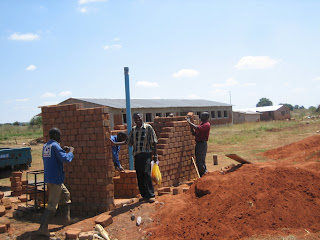
We awarded training certificates to our students today. SHIP's operations director leveraged our work by convincing Mobile Missions to construct the structure of the twin VIP. They are learning a German technology that allows bricks to be made at very little cost (76 bricks from 110# bag of cement) and laid with very little mortar. They used our latrine site as a training site, so we gave them a donation for helping us out. They were close to finished when we left. It has been a great experience as always. The students were very grateful and anxious to help make Zambia a better place.

Thursday, April 17, 2008

One done, one to go


This is a picture of  the nearly completed arborloo. This is overkill on the materials I will admit, because it is intended to be made from the cheapest of materials (like bamboo walls). When an arborloo fills up, you simply move it to a new pit and plant a fruit tree where the old pit was. Since this is a demo latrine, we have invited the community to use this, so it might get moved every few weeks. The vision is for a row of fruit trees. Jerry was able to line up a team from Mobile Missions to construct the structure of the twin VIP from hydroformed bricks - completed picture tomorrow I hope.

Tuesday, April 15, 2008

2nd day 2nd week of training in Mapalo


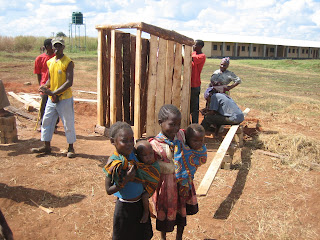
We have essentially finished the construction of the Arborloo latrine which is ready to use and the pit for the twin VIP today. We have to wait one more day for the slab to cure on the twin VIP, so tomorrow will be dedicated to refreshing everyone on design, latrine types, promotion, etc. The picture is a little sad - the girl on the left is 5 yrs old and hauled that baby around all day long.

Sunday, April 13, 2008

Zambia Sanitation 1 week gone by


The first week went by incredibly fast, but it was good to get a rest this weekend. You haven't lived until you worship Yehway (God) in an African church. I made a couple short videos, but they don't begin to do it justice. The picture shows our students, who we've been training in between construction steps, working on the slab for the twin VIP. It is going to be REALLY interesting trying to move about a ton of concrete on Thursday after the cement has cured.